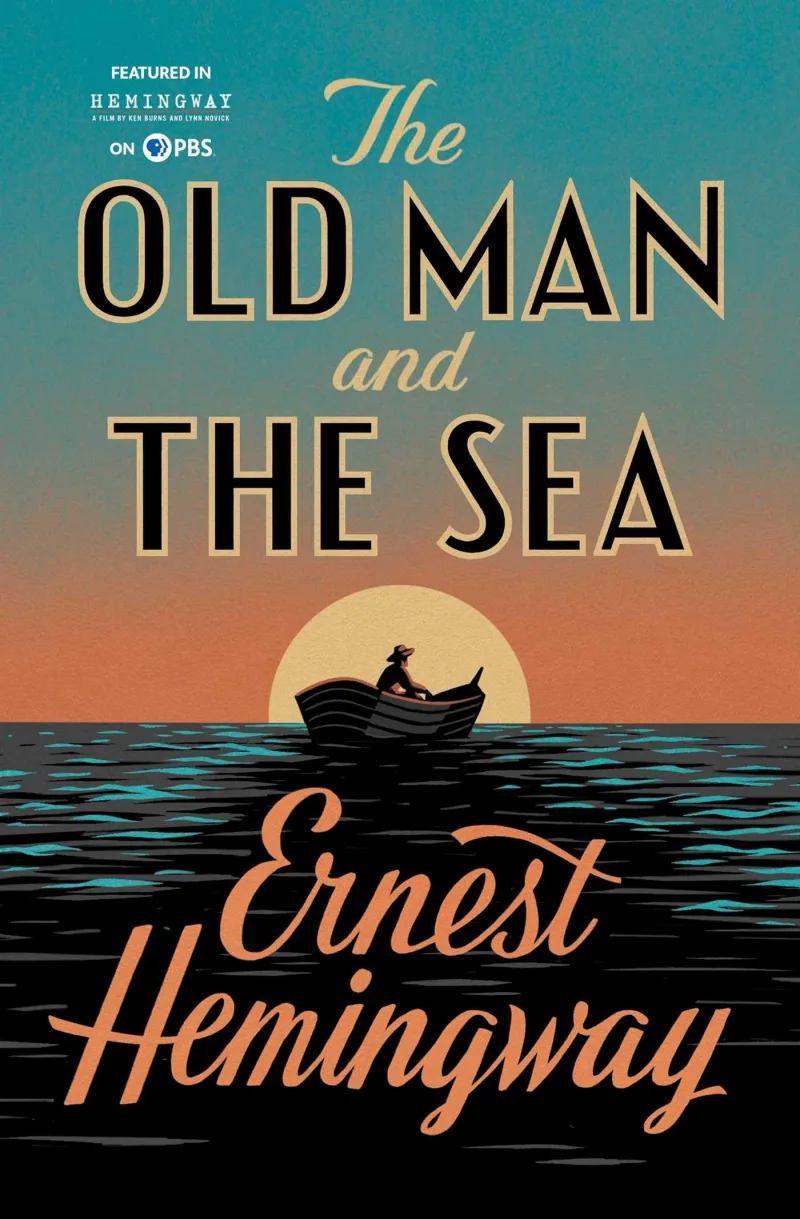
The Old Man and the Sea
by Ernest Hemingway
Stoic, Elegiac
A real, unedited Premium analysis of a published book, produced by the same engine that reads your manuscript. Shown to demonstrate ProofIntelligence — it is not an endorsement by, or affiliated with, the author or publisher.
An aging Cuban fisherman's epic three-day battle with a giant marlin far out in the Gulf Stream becomes a profound meditation on endurance, pride, defeat, and the unbreakable human spirit.
Executive Summary
Ernest Hemingway's 'The Old Man and the Sea' is a 27,000-word novella that stands as one of the supreme achievements of 20th-century literary fiction. It tells the story of Santiago, an aging Cuban fisherman who hooks an enormous marlin after 84 days without a catch, battles it for two days and nights alone in the Gulf Stream, kills it, and then loses it to sharks on the voyage home — arriving with nothing but a skeleton lashed to his skiff. The prose exemplifies Hemingway's iceberg theory at its most refined: deceptively simple sentences carrying enormous thematic weight about endurance, pride, mortality, and man's relationship with nature. The novella won the Pulitzer Prize in 1953 and was cited in Hemingway's 1954 Nobel Prize. For the Indian market, it remains a perennial seller through academic channels and general literary readership, with opportunities for annotated editions, regional language translations, and illustrated formats.
Hemingway's 'The Old Man and the Sea' remains one of the most commercially reliable literary properties in world publishing — a 27,000-word novella that has sold over 10 million copies and been translated into 50+ languages. For the Indian market, the opportunity lies in a definitive annotated edition positioned for both academic adoption (CBSE/ICSE supplementary lists, university literature courses) and general literary readership, comparable to Penguin Classics' annotated editions of Dostoevsky or Tolstoy. The novella's themes of endurance, aging, and man-versus-nature resonate deeply with Indian literary sensibilities and coastal fishing cultures. A well-designed Indian edition with scholarly apparatus, priced at ₹299-₹399, could capture significant market share from existing generic editions while establishing a publisher's literary credentials.
For any new edition targeting the Indian market, the single highest-impact addition would be a contextual introduction and annotations explaining the baseball references (DiMaggio, bone spurs, the Yankees) and Cuban fishing culture, which would significantly improve accessibility for Indian readers unfamiliar with 1950s American cultural context — particularly in the middle sections where these references are most dense.
Full text of the complete novella provided. This is a canonical work of world literature — Ernest Hemingway's Pulitzer Prize-winning novella (1952). Analysis is based on the entire manuscript with high confidence in craft and market assessments.
This is Ernest Hemingway's 'The Old Man and the Sea,' a Pulitzer Prize-winning masterpiece of literary fiction that exemplifies the iceberg theory of prose — spare, muscular sentences carrying enormous thematic weight beneath the surface. The novella's craft scores are among the highest achievable in literary fiction, with its market positioning secured by its canonical status and universal themes of endurance, dignity, and man's relationship with nature.
Score Breakdown
Six craft dimensions and six market dimensions, each labelled by the analyser for this book.
Structure
Santiago, an old Cuban fisherman, has gone 84 days without catching a fish. His young apprentice Manolin has been forced by his parents to fish on a luckier boat. The two share a deep bond, discussing baseball, eating together, and preparing for Santiago's next voyage far out to sea.
The opening is masterfully economical. In a few pages, Hemingway establishes character, relationship, setting, and thematic stakes. The fiction of the cast net and the yellow rice reveals the depth of poverty and mutual care without sentimentality.
Santiago hooks an enormous marlin that tows his skiff for two full days and nights. He endures cramped hands, exhaustion, hunger, and isolation while maintaining a spiritual dialogue with the fish he both loves and must kill. He finally brings the marlin alongside and harpoons it after an agonizing series of circling approaches.
The middle section is a sustained masterclass in tension, interiority, and physical detail. Hemingway maintains reader engagement through a single-character, single-setting scenario for over 70 pages — an extraordinary feat of narrative control.
Sharks attack the marlin lashed to the skiff. Santiago fights them with harpoon, knife, club, and tiller, losing each weapon in turn. By the time he reaches harbour, only the skeleton remains. Manolin finds him sleeping, vows to fish with him again, and Santiago dreams of the lions on the African beaches.
The ending achieves a devastating emotional resonance. The tourist's misidentification of the skeleton as a shark provides bitter irony, while the final image of Santiago dreaming of lions is one of the most iconic closings in literature.
Pacing
The pacing follows a classical dramatic arc with a slow, deliberate build through the first third, sustained tension through the middle, a climactic peak at the kill (position 75), and a devastating falling action through the shark attacks. The energy never truly drops to zero — even the quiet opening carries undercurrent tension from Santiago's 84-day streak. The novella's genius is maintaining high engagement through a single-character, single-setting scenario for its entire middle section.
Narrative Tension
Story Arc
Peak: Santiago drives the harpoon into the marlin's heart — the fish rises its full length from the water, hangs in the air above the old man, then crashes back into the sea. The moment is simultaneously the story's greatest triumph and the beginning of its tragedy.
The tension curve follows a masterful double-peak structure. The first peak is the harpooning of the marlin (position 75, tension 95) — the culmination of two days of physical and spiritual contest. Rather than resolving, tension remains elevated through the shark attacks (positions 80-95), creating a devastating second act where victory is systematically dismantled. The final drop to the harbour is not relief but exhaustion — the tension resolves into elegy rather than triumph.
Emotional Rhythm
Emotional Journey
The emotional journey traces a profound arc from quiet desperation through hope, endurance, triumph, and devastating loss, finally arriving at a bittersweet peace. The emotional range is extraordinary for such a short work — Hemingway achieves the full spectrum of human feeling through a single character's physical ordeal. The most powerful emotional shift occurs between positions 75 and 85, where triumph collapses into anguish within pages. The final return to positive valence — Santiago dreaming of lions — is earned through suffering rather than resolution, making it one of literature's most moving endings.
Chapter Audit
Every chapter read and rated — 20 in this book.
Opening — The Village
Santiago's 84-day unlucky streak is established; his bond with Manolin is revealed through shared rituals and gentle fictions.
Perfect exposition — character, stakes, and theme in minimal prose.
Night and Dreams
Santiago dreams of Africa and lions, establishing the recurring motif of youth and vitality.
Lions motif introduced — bookends the entire novella beautifully.
Setting Out
Santiago rows out before dawn, past the other fishermen, into deep water far beyond the usual fishing grounds.
Methodical pacing builds anticipation; sea descriptions luminous.
The Hook
Santiago feels the first tentative pull on his line — a marlin at 100 fathoms takes the bait.
Tension masterfully escalated through tactile, sensory detail.
The Tow Begins
The marlin begins towing the skiff northwest; Santiago braces against the line, unable to raise the fish.
Man-versus-nature conflict crystallized in physical endurance.
First Night at Sea
Santiago endures the cold night, thinks of DiMaggio, porpoises, and his brotherhood with the fish.
Interior monologue deepens character; baseball motif grounds him.
The Cramped Hand
Santiago's left hand cramps; he eats raw bonito to regain strength while maintaining the line.
Physical suffering rendered with clinical precision and dignity.
The Marlin Surfaces
The great fish finally jumps, revealing its enormous size — two feet longer than the skiff.
Peak visual moment — the marlin's beauty and scale are breathtaking.
The Arm-Wrestling Memory
Santiago recalls his legendary arm-wrestling match in Casablanca, drawing strength from past endurance.
Flashback earns its place — parallels the current contest perfectly.
Second Night — Dolphin and Sleep
Santiago catches a dolphin, eats it raw, and manages brief sleep while the fish pulls on.
Survival details accumulate; exhaustion becomes palpable.
The Fish Circles
On the third day, the marlin begins circling — Santiago pulls him closer with each revolution.
Unbearable tension — each circle tightens the narrative spring.
The Kill
Santiago drives the harpoon into the marlin's heart; the great fish rises and crashes back into the sea.
Climactic moment — simultaneously triumphant and tragic.
Lashing and Sailing Home
Santiago lashes the marlin alongside and begins sailing southwest toward Havana.
Brief respite before the devastating shark attacks begin.
The Mako Shark
The first shark — a great Mako — attacks the marlin; Santiago kills it with the harpoon but loses the weapon.
Each shark strips away a weapon — structural genius in escalation.
Galanos Attack
Shovel-nosed sharks attack in pairs; Santiago fights with knife-on-oar, then the knife blade snaps.
Relentless degradation — hope erodes with each lost tool.
The Club Fight
More sharks come at sunset; Santiago fights with the broken oar club, losing more of the marlin.
Physical and spiritual exhaustion converge powerfully.
The Final Pack
At midnight, a pack of sharks strips the marlin to skeleton; Santiago fights with the tiller until it breaks.
Total defeat rendered without self-pity — devastating and dignified.
Return to Harbour
Santiago sails into the harbour, climbs the hill with the mast, collapses in his shack.
The climb with the mast — unmistakable crucifixion imagery.
Morning After — Manolin Returns
Manolin finds Santiago, brings coffee, weeps, and vows to fish with him again regardless of his parents.
Emotional payoff earned through restraint — the boy's tears say everything.
The Tourists and the Lions
Tourists mistake the skeleton for a shark; Santiago sleeps, dreaming of the lions on the beach.
Perfect ironic coda — the world misreads; Santiago transcends.
What's Working
Unmatched Prose Economy
Every sentence earns its place. Hemingway achieves in 127 pages what most writers cannot in 500 — a complete emotional and philosophical journey rendered in prose so spare it feels inevitable. The 'flag of permanent defeat' image in the opening paragraph sets the entire thematic register.
Profound Thematic Depth
The novella operates simultaneously as adventure story, character study, philosophical meditation, and Christian allegory. The marlin as brother, the sharks as entropy, Santiago's mast-carrying as crucifixion — layers of meaning reward infinite rereading without ever feeling forced.
Masterful Tension Sustenance
Hemingway maintains unbearable narrative tension across a two-day, single-character, single-setting scenario with no dialogue partners. The physical details of line, hand, fish, and sea create a visceral reading experience that never flags despite minimal plot mechanics.
Universal Emotional Resonance
The themes of aging, endurance, pride, defeat, and the relationship between mentor and apprentice transcend culture, language, and era. This universality has made the novella a perennial bestseller across 50+ languages and ensures continued market relevance.
Ideal Length for Modern Market
At approximately 27,000 words, the novella is perfectly positioned for the growing 'short literary fiction' market — ideal for single-sitting reads, book clubs, academic courses, and audiobook consumption. Its brevity is a commercial asset in an attention-scarce era.
What to Fix
Limited Scalability
As a standalone novella with a self-contained arc and no sequel potential, the work cannot generate series revenue or sustained franchise engagement. Santiago's story is complete — there is nowhere else to go.
Pacing May Challenge Contemporary Readers
The extended middle section — Santiago alone on the boat for two days — relies on interior monologue and physical detail rather than plot events. Modern readers accustomed to faster pacing may find sections repetitive, particularly the repeated wishes for the boy and DiMaggio references.
Narrow Cast Limits Commercial Appeal
With essentially one character for 80% of the narrative and no romantic subplot, ensemble dynamics, or multiple POVs, the novella lacks the character variety that drives commercial fiction sales and broad adaptation potential.
Cultural Specificity of Baseball References
The extended DiMaggio/baseball passages, while thematically functional, may alienate Indian readers unfamiliar with 1950s American baseball culture. These references require contextual knowledge that reduces immediate accessibility.
Dated Racial Language
The arm-wrestling passage refers to Santiago's opponent as 'the negro' repeatedly — language that was standard in 1952 but requires sensitivity framing for contemporary Indian and international editions.
Contextual Apparatus
Throughout — especially middle sectionsBaseball and 1950s American cultural references are opaque to Indian readers
Commission a scholarly introduction and footnotes from an Indian academic specializing in American literature, contextualizing DiMaggio, the Cuban fishing economy, and Hemingway's biographical connection to the material
Sensitivity Review
Arm-wrestling flashback sectionRepeated use of 'the negro' in the arm-wrestling passage and gendered language about the sea
Add a publisher's note addressing historical language conventions rather than altering the text; include a brief essay on reading classic literature in contemporary context
Visual Enhancement
Opening village scenes and sea descriptionsThe novella's marine world is richly described but may be unfamiliar to inland Indian readers
For an illustrated edition, commission artwork depicting the Gulf Stream ecosystem, marlin anatomy, and Cuban fishing village life to enhance reader immersion
Character
Santiago
complete
From a man seeking external validation through a great catch to one who has proven his endurance to himself, accepting defeat without being destroyed by it
Santiago's arc is one of the most complete in literary fiction. His transformation is not from weakness to strength but from untested resolve to proven endurance. The arc's power lies in its paradox — he achieves his greatest triumph and his greatest defeat simultaneously, and emerges spiritually intact.
The Sea / Nature / Entropy
The antagonist is not the marlin (who is Santiago's brother) but the indifferent universe itself — embodied by the sharks, the current, the distance, and time. The threat is existential rather than personal, which gives the novella its philosophical weight.
Prose & Voice
Hemingway's prose in this novella represents the apex of his iceberg theory — every sentence carries weight far beyond its surface meaning. The style is deceptively simple: short declarative sentences, minimal adjectives, concrete nouns, and an almost biblical cadence. Yet beneath this simplicity lies extraordinary subtext — Santiago's monologues about the fish, DiMaggio, and the lions carry layers of meaning about mortality, pride, and grace under pressure. The prose is simultaneously accessible to a teenager and inexhaustible for a scholar.
“Everything about him was old except his eyes and they were the same color as the sea and were cheerful and undefeated.”
“The sail was patched with flour sacks and, furled, it looked like the flag of permanent defeat.”
“He always thought of the sea as la mar which is what people call her in Spanish when they love her.”
“A man can be destroyed but not defeated.”
“Then the fish came alive, with his death in him, and rose high out of the water showing all his great length and width and all his power and his beauty.”
“He had played the hand game with the great negro from Cienfuegos who was the strongest man on the docks.”
“Do you think we should buy a terminal of the lottery with an eighty-five?”
Market & Audience
As a canonical work, market positioning is established. In India, the novella has strong academic demand (CBSE/ICSE supplementary reading, university literature courses) and steady general readership. New editions — particularly illustrated, annotated, or translated into Indian languages — represent the primary market opportunity.
- As a 70+ year old work, it faces competition from numerous existing editions and free public domain versions in some markets
- Literary fiction novellas have a smaller commercial ceiling than genre fiction or full-length novels
- Younger readers may find the pacing slow compared to contemporary fiction
- Canonical status ensures perpetual academic and institutional demand
- The novella's brevity makes it ideal for the growing 'short reads' market segment
- Film/TV adaptation potential and audiobook formats can introduce the work to new audiences
Publishing Plan
As a Pulitzer Prize-winning canonical work, the text itself requires no editorial intervention. Publishing readiness is essentially about edition design rather than manuscript quality. For the Indian market, the primary editorial need is contextual apparatus — annotations, introduction, and cultural framing — to maximize accessibility for readers unfamiliar with 1950s Cuban-American culture. The text is in the public domain in many jurisdictions, which creates both opportunity (low acquisition cost) and challenge (competition from free editions).
- For a new Indian edition: commission scholarly introduction and cultural annotations
- Add a publisher's note addressing dated racial language in the arm-wrestling passage
- Consider an illustrated edition with artwork depicting the Gulf Stream marine ecosystem
- Include a glossary of Spanish terms and Cuban cultural references
Contextual apparatus — commission scholarly introduction, cultural annotations for baseball references, Cuban terminology, and historical context for Indian readers
Sensitivity review and publisher's note — address dated racial language in arm-wrestling passage; add contextual framing for contemporary readership without altering original text
Edition design — cover brief execution, illustrated elements for marine ecosystem, glossary of Spanish terms, and reading guide for book clubs and academic use
Comparable Titles
Moby-Dick
The foundational man-versus-sea-creature narrative in American literature. Both works use a single obsessive pursuit as vehicle for philosophical meditation on nature, mortality, and human will. Where Ahab is destroyed by his obsession, Santiago is ennobled by his — the key thematic divergence.
The Pearl
A short, parable-like novella about a poor fisherman whose great catch brings destruction rather than salvation. Both works use deceptively simple prose to explore how nature's gifts become curses, and both are staples of academic literature curricula worldwide, including in India.
The Hungry Tide
An Indian literary novel deeply engaged with the relationship between humans and the sea, set in the Sundarbans. Shares thematic DNA with Hemingway's novella — the ocean as both provider and destroyer, fishing communities' intimate knowledge of nature, and the tension between human ambition and natural forces. Provides the Indian literary context for positioning Hemingway's work.
Reach & Rights
The novella's translation viability is among the highest of any 20th-century work. Its themes — endurance, aging, dignity, man versus nature — are genuinely universal. The prose style, while iconic in English, is paradoxically well-suited to translation because of its simplicity and concreteness. The primary barriers are cultural references (baseball, Cuban specifics) rather than linguistic complexity. In India specifically, the novella resonates powerfully with coastal fishing communities and the broader cultural value placed on perseverance and elder wisdom.
This is definitively a standalone work. Its power derives from compression and finality — Santiago's story cannot be extended without diluting its impact. However, the world Hemingway created (the Cuban fishing village, the Gulf Stream ecosystem) could theoretically support companion works by other authors, and Manolin's character has enough depth to anchor a separate narrative. These are academic possibilities rather than commercial ones.
An aging fisherman's three-day battle with a giant marlin becomes a visually stunning survival drama about the cost of pride and the dignity of defeat — a one-man show on the open ocean.
The work is in the public domain in many jurisdictions (life + 70 years in some countries, though US copyright extends through 2047). For the Indian market, focus on creating a definitive audiobook in English and Hindi, and pursue illustrated edition rights. Film adaptation rights would need to be negotiated with the Hemingway estate through Scribner's/Simon & Schuster.
The Package
Written for you, ready to send — the back cover, the pitch and the shelf it sits on.
Santiago is old, unlucky, and alone. Eighty-four days without a fish. His young apprentice Manolin has been forced onto a luckier boat. But Santiago rows out further than anyone dares — and hooks a marlin so enormous it tows his skiff for two days and nights. What follows is one of literature's greatest contests: man against fish, will against nature, pride against the indifferent sea. When Santiago finally kills the marlin, his true battle has only begun — sharks circle, and everything he has won begins to be stripped away.
After 84 days without a catch, an old Cuban fisherman rows far out into the Gulf Stream and hooks the greatest marlin anyone has ever seen. What follows is a three-day battle of endurance, will, and spirit — a story of triumph and loss that asks what it means to be undefeated.
After eighty-four days without a catch, an old Cuban fisherman rows alone into the Gulf Stream and hooks a marlin so enormous it tows his skiff for two days — and what he brings home is not what he expected, but something far more profound.
Santiago is old, unlucky, and alone. His young apprentice has been forced onto another boat. But on the eighty-fifth day, he rows further out than anyone dares and hooks the greatest marlin the Gulf Stream has ever produced. Over three days and nights, man and fish wage a battle of endurance that becomes a meditation on aging, pride, and what it means to be undefeated. When Santiago finally kills the marlin, sharks descend — and his greatest triumph becomes his greatest loss. Yet in the stripped skeleton he brings home, and in the boy who refuses to leave him again, something indestructible remains. At 27,000 words, this novella combines the visceral immediacy of adventure fiction with the philosophical depth of the finest literary tradition.
- Books > Literature & Fiction > Literary Fiction
- Books > Literature & Fiction > Classics
- Books > Literature & Fiction > Sea Adventures
Content Advisory
The primary sensitivity concern is the repeated use of 'the negro' to describe Santiago's arm-wrestling opponent in the Casablanca flashback. This language was standard in 1952 American English but requires a publisher's note in contemporary editions. The depiction of the sea as feminine ('la mar') and the gendered language around it reflects the character's cultural context rather than authorial endorsement. The Catholic prayer passages are integral to character and should not be flagged as problematic. Overall, the novella is remarkably clean by contemporary standards — no sexual content, no substance abuse, no domestic violence.
Your book deserves this analysis
Get a Premium ProofIntelligence report on your own manuscript — and register it with tamper-proof timestamps that prove your authorship forever.
Free plan available · no credit card to start.
Scores and commentary are produced by ProofIntelligence and reflect this analysis only. Titles and authors are named for identification; ProofBooks claims no affiliation with, or endorsement by, them.