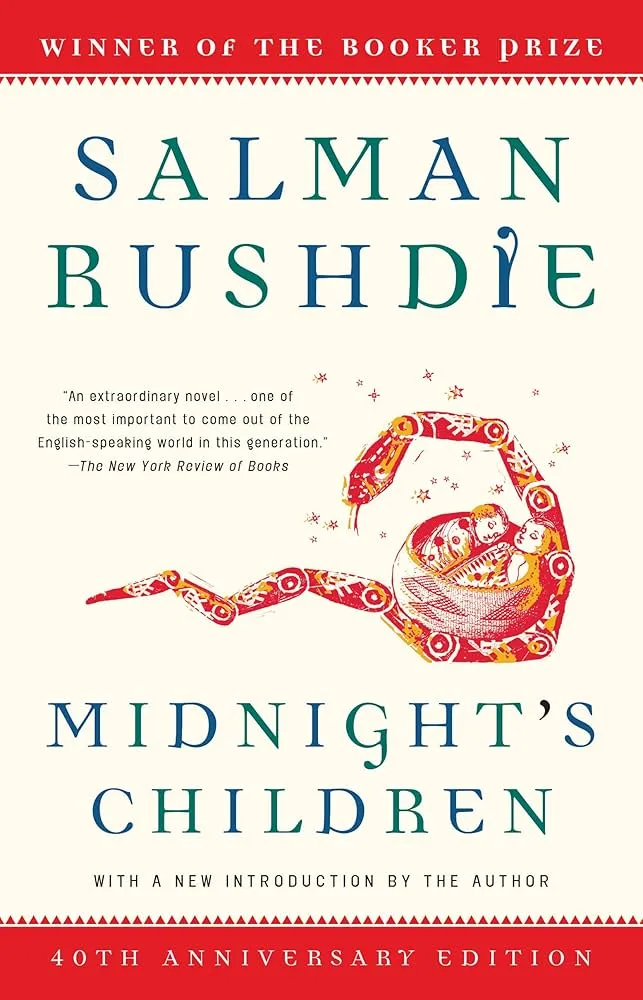
Midnight's Children
by Salman Rushdie
Exuberant, Tragicomic
A real, unedited Premium analysis of a published book, produced by the same engine that reads your manuscript. Shown to demonstrate ProofIntelligence — it is not an endorsement by, or affiliated with, the author or publisher.
Born at the exact moment of India's independence, Saleem Sinai discovers he is telepathically linked to all 1,001 children born in that midnight hour—and that his fate is inextricably handcuffed to the destiny of the nation itself.
Executive Summary
Midnight's Children is Salman Rushdie's magnum opus, a sprawling, exuberant novel that tells the story of Saleem Sinai, born at the precise stroke of midnight on August 15, 1947—the moment of India's independence. Through Saleem's unreliable, garrulous narration, the novel traces three generations of an Indian family from Kashmir to Bombay to Pakistan and back, weaving personal history with national destiny through the device of telepathic midnight children. The prose is a revolutionary fusion of English with Indian linguistic rhythms, oral storytelling traditions, and Bombay cinema aesthetics. The novel's structural ambition—thirty pickle jars of preserved memory—mirrors its thematic preoccupation with the relationship between individual identity and national history, the unreliability of memory, and the terrible costs of political power.
Midnight's Children is the defining novel of postcolonial Indian literature—a work that did for Indian fiction what García Márquez's One Hundred Years of Solitude did for Latin American letters. Salman Rushdie's magnum opus tells the story of Saleem Sinai, born at the stroke of midnight on August 15, 1947, whose life becomes inextricably linked to the fate of independent India through telepathy, a prodigious nose, and the company of 1,001 magical midnight children. The novel's revolutionary prose voice—a torrential, polyglot, self-interrupting stream that fuses English with Hindi, Urdu, and Bombay street slang—created a template for an entire generation of Indian English-language writers. Winner of the Booker Prize and the 'Best of the Booker,' with proven commercial viability across 30+ languages and 40+ years of continuous print, this is a permanent fixture of the global literary canon with guaranteed institutional and retail demand.
This is a published classic that has already undergone professional editing (by Liz Calder at Jonathan Cape). No improvement lever is applicable in the traditional editorial sense. However, for new editions, enhanced footnotes or a glossary of historical references and Hindi/Urdu terms (particularly for international readers unfamiliar with the Emergency, Partition politics, and Indian cultural references) would significantly improve accessibility without compromising the text.
Full text of the complete novel provided, including Rushdie's own introduction. This is a published, Booker Prize-winning classic; analysis is based on comprehensive reading of the entire manuscript.
Midnight's Children is a masterwork of postcolonial literature that fuses magical realism, political allegory, and autobiographical fiction into a singular narrative voice. The novel's craft scores are among the highest achievable—its linguistic innovation, thematic depth, and structural ambition place it in the rarest tier of English-language fiction. Its market viability is proven by decades of commercial success, the Booker Prize, and the 'Best of the Booker' distinction.
Score Breakdown
Six craft dimensions and six market dimensions, each labelled by the analyser for this book.
Structure
Book One traces three generations before Saleem's birth: his grandfather Aadam Aziz's loss of faith in Kashmir, his courtship of Naseem through a perforated sheet, the family's move to Agra, the Hummingbird's assassination, Nadir Khan's underground marriage to Mumtaz, and finally Amina's remarriage to Ahmed Sinai and their move to Bombay, culminating in Saleem's birth at midnight on August 15, 1947.
The opening is masterfully constructed, establishing the novel's voice, themes, and generational patterns with extraordinary confidence. The delayed arrival of the protagonist (not born until the end of Book One) is a bold structural choice that pays off by making Saleem's birth feel cosmically inevitable.
Book Two covers Saleem's childhood in Bombay from 1947-1965: his discovery of telepathy, the Midnight Children's Conference, his mother's secret meetings with Nadir Khan, the revelation of Mary Pereira's baby-swap, the Sabarmati affair, and the family's exile to Pakistan, where Jamila Singer rises to fame and Saleem's sinuses are drained, severing his telepathic connection.
Book Two is the novel's richest section, balancing the exuberance of childhood discovery with mounting political darkness. The parallel between Saleem's personal disintegration and India's political fractures is sustained with remarkable precision.
Book Three follows Saleem through the 1971 Bangladesh war as an amnesiac soldier ('the buddha'), his return to India via Parvati-the-witch's magic basket, his marriage to Parvati, the birth of his son Aadam during the Emergency, and his capture and sterilization by the Widow's regime, ending with his work as a pickle-factory manager writing his memoirs before his anticipated death.
The ending is devastating and inevitable, bringing together every thread of the novel's vast tapestry. The acceleration of the narrative mirrors Saleem's physical cracking apart, and the final vision of being trampled by the multitudes is both terrifying and oddly peaceful—the individual dissolved back into the nation.
Pacing
The pacing follows a distinctive pattern of gradual acceleration across the novel's three books. Book One is the most leisurely, establishing three generations before the protagonist's birth. Book Two picks up speed as Saleem's childhood unfolds. Book Three accelerates dramatically, with events compressed and the prose itself becoming more fragmented and urgent—mirroring Saleem's physical and mental disintegration. The novel's energy peaks in its final chapters, where the Emergency and the destruction of the midnight children are narrated with breathless, almost unbearable intensity.
Narrative Tension
Story Arc
Peak: The sterilization and 'sperectomy' of the midnight children in the Widows' Hostel—the systematic destruction of an entire generation's magical potential by the state, narrated with unbearable intimacy by the one who betrayed them all.
The tension curve follows a distinctive pattern of escalation-and-release across three books, with each book ending in a devastating climax. Book One builds to the midnight birth; Book Two to the family's destruction in the 1965 war; Book Three to the Emergency and the annihilation of the midnight children. The novel's genius is in maintaining reader engagement through the quieter passages via the sheer energy of the prose voice and the constant promise of revelation.
Emotional Rhythm
Emotional Journey
The emotional arc of Midnight's Children traces a long, devastating descent from the euphoria of birth and independence to the despair of sterilization and annihilation, with the novel's final note being one of bittersweet acceptance. The genius of the emotional design is that the descent is not monotonic—there are genuine moments of joy, wonder, and comedy throughout, even in the darkest sections, creating a tragicomic rhythm that mirrors the Indian experience of the postcolonial decades.
Chapter Audit
Every chapter read and rated — 30 in this book.
The Perforated Sheet
Aadam Aziz loses his faith in Kashmir, meets Naseem Ghani through a hole in a bedsheet, and falls in love piece by piece.
Establishes every major theme in a single brilliant chapter.
Mercurochrome
Aadam and Naseem marry, move to Amritsar, and survive the Jallianwala Bagh massacre through a providential sneeze.
History and personal fate fused with breathtaking skill.
Hit-the-Spittoon
The Hummingbird's assassination, Nadir Khan's flight, and the introduction of the spittoon motif.
Dense with incident; establishes political allegory patterns.
Under the Carpet
Nadir Khan hides in the Aziz cellar, marries Mumtaz, but the marriage is never consummated.
Underground marriage mirrors India's hidden histories.
A Public Announcement
Amina moves to Delhi, encounters the Ravana gang, and publicly announces her pregnancy to save Lifafa Das.
Amina's courage and the prophecy scene are unforgettable.
Many-headed Monsters
Amina visits Ramram Seth for a prophecy; Ahmed's godown burns; the family decides to move to Bombay.
The prophecy scene is one of the novel's great set-pieces.
Methwold
The Sinais move into Methwold's Estate in Bombay; William Methwold's eccentric conditions of sale are established.
Methwold's center-parting as colonial legacy—brilliant.
Tick, Tock
The countdown to midnight, August 15, 1947: Saleem's birth, Mary Pereira's baby-swap, and Vanita's death.
The novel's climactic birth scene is perfectly orchestrated.
The Fisherman's Pointing Finger
Saleem's infancy, Ahmed's alcoholism, the freeze of assets, and the family's early years in Bombay.
Establishes Bombay childhood world with vivid detail.
Snakes and Ladders
Amina's secret racetrack gambling, the arrival of Doctor Schaapsteker, and Saleem's typhoid cured by cobra venom.
The snakes-and-ladders metaphor perfectly captures fate.
Accident in a Washing-chest
Saleem discovers his mother's secret phone calls, hides in a washing-chest, and his telepathic powers are activated by a violent sniff.
The origin of Saleem's powers—comic and profound.
All-India Radio
Saleem explores his telepathic abilities, eavesdrops on family and strangers, and begins cheating in school.
Telepathy as metaphor for the novelist's omniscience.
Love in Bombay
Evie Burns arrives, Saleem falls in love, and the language riots are accidentally triggered by his chant.
Personal desire and political chaos perfectly intertwined.
My Tenth Birthday
The Midnight Children's Conference is formally established; Saleem discovers 581 children with magical gifts.
The novel's central conceit fully revealed—electrifying.
At the Pioneer Café
Saleem follows his mother to the Pioneer Café and discovers her meetings with Nadir Khan/Qasim the Red.
Maternal betrayal drives Saleem's revenge plot.
Alpha and Omega
The blood-type revelation after Saleem's finger is crushed; the family learns he is not their biological son.
The novel's most devastating revelation—perfectly timed.
The Kolynos Kid
Saleem's exile to Uncle Hanif's apartment; his infatuation with Aunt Pia; Hanif's suicide.
Hanif's death deepens the novel's tragic undertow.
Commander Sabarmati's Baton
Saleem engineers the Sabarmati murder through anonymous newspaper-clipping notes, triggering the destruction of Methwold's Estate.
Saleem as puppet-master—his most consequential act.
Revelations
Mary Pereira's confession, Aadam Aziz's vision of God, and the family's disintegration during mourning.
Multiple revelations cascade with devastating force.
Movements Performed by Pepperpots
The family moves to Pakistan; Saleem assists in Ayub Khan's military coup using pepperpots as symbols.
Pepperpot coup—history as tabletop game.
Drainage and the Desert
Saleem's sinuses are drained, severing his telepathic connection; the family prepares to leave Bombay.
The cruelest act—parents destroy their son's gift.
Jamila Singer
Jamila's rise to fame in Pakistan; Saleem discovers his sense of smell; his forbidden love for his sister.
Smell replaces telepathy; incestuous love emerges.
How Saleem Achieved Purity
The 1965 war destroys Saleem's family; a silver spittoon strikes him on the head, erasing his memory.
The war as personal apocalypse—devastating climax.
The Buddha
Amnesiac Saleem becomes a military tracker in the CUTIA unit, following scent trails across Bangladesh.
The buddha persona—emptied of self, pure instrument.
In the Sundarbans
The soldiers flee into the jungle, where they are tormented by ghosts, seduced by phantom women, and nearly dissolved.
The Sundarbans as purgatory—hallucinatory and terrifying.
Sam and the Tiger
The fall of Dacca; Saleem is reunited with Parvati-the-witch and made invisible in her basket.
Reunion through magic—Parvati's basket as rebirth.
The Shadow of the Mosque
Saleem lives in the magicians' ghetto in Delhi; his failed attempt to gain patronage from Uncle Mustapha.
The magicians' colony as alternative India.
A Wedding
Saleem marries Parvati; the Emergency is declared; Aadam Sinai is born at midnight on June 25, 1975.
Birth and Emergency synchronized—the novel's second midnight.
Midnight
The midnight children are rounded up, sterilized, and drained of their powers by the Widow's regime.
The novel's darkest chapter—annihilation of possibility.
Abracadabra
Saleem returns to Bombay, finds Mary Pereira, begins work at the pickle factory, and prepares for his death.
Full circle—memory preserved in pickle jars.
What's Working
Revolutionary Prose Voice
Rushdie's narrative voice is one of the most distinctive in English literature—a torrential, polyglot, self-interrupting stream that fuses Urdu cadences, Bombay slang, English literary tradition, and oral storytelling into something entirely new. The voice of Saleem Sinai is simultaneously comic and tragic, grandiose and self-deprecating.
Structural Innovation
The novel's architecture—thirty chapters mirroring thirty pickle jars, the frame narrative with Padma, the interweaving of personal and national timelines—is brilliantly conceived. The perforated sheet motif recurs across generations, binding the narrative together with thematic precision.
Thematic Depth & Political Allegory
The novel operates simultaneously as family saga, political history, magical realist fable, and meditation on memory and identity. The equation of Saleem with India—both born at midnight, both cracking apart—is sustained with extraordinary intellectual rigor across 600+ pages.
Proven Commercial Track Record
Winner of the Booker Prize (1981) and the 'Best of the Booker' (2008), the novel has sold millions of copies worldwide, been translated into dozens of languages, and remains continuously in print after 40+ years. It single-handedly catalyzed the boom in Indian English-language fiction.
Unmatched Market Differentiation
No other novel occupies the precise literary space of Midnight's Children—the fusion of Indian history, magical realism, and postcolonial critique in English prose. It created a genre and remains its defining text, making it essentially without competition in its category.
What to Fix
Density & Accessibility Barriers
The novel's sheer density—its digressions, its encyclopedic scope, its demanding prose style—can alienate casual readers. The first 100 pages, covering Saleem's grandparents and parents before his birth, require significant patience from readers expecting the protagonist's story to begin.
Narrative Reliability as Double-Edged Sword
Saleem's acknowledged unreliability (the Gandhi assassination date error, the deliberate lie about Shiva's death) is thematically purposeful but can frustrate readers seeking historical accuracy. The novel's relationship with 'truth' is sophisticated but occasionally disorienting.
Pacing Unevenness in Book Three
The Pakistan and Bangladesh sections (Book Three) feel compressed compared to the leisurely Bombay childhood of Book Two. The war sequences and the Sundarbans episode, while powerful, rush through events that could benefit from the same granular attention given to earlier sections.
Niche Literary Audience
Despite its commercial success, the novel's primary audience remains literary readers, academics, and the Indian diaspora. Its length, complexity, and cultural specificity limit its appeal to mass-market readers seeking accessible entertainment.
Cultural Specificity as Market Limitation
The novel's deep immersion in Indian history, politics, religion, and language—while its greatest strength—requires significant cultural literacy from non-Indian readers. References to the Emergency, Partition, and dozens of political figures assume knowledge that international readers may lack.
Accessibility
All chaptersCultural and historical references assume deep familiarity with Indian politics 1915-1977
For new editions, include a timeline of Indian history and a glossary of Hindi/Urdu terms as appendices, without altering the text itself
Pacing
Book Three - all chaptersBook Three compresses events that received more expansive treatment in Books One and Two
This is a structural choice that serves the novel's theme of acceleration and disintegration; no change recommended, but readers should be prepared for the shift in tempo
Reader Onboarding
Book One - The Perforated Sheet through MethwoldThe novel's opening chapters focus on grandparents and parents before the protagonist is born, which can test reader patience
The introduction by Rushdie himself helps contextualize this choice; for new editions, consider a brief reader's note about the novel's generational structure
Character
Saleem Sinai
complete
From a child who believes he is the mirror of the nation to a broken man who understands that he is merely one of six hundred million specks of dust—but who finds purpose in the humble act of pickling memories before he crumbles
Saleem's arc is one of the most complete and devastating in modern fiction. His journey from grandiose midnight child to humbled pickle-maker encompasses the full spectrum of postcolonial experience—hope, disillusion, exile, mutilation, and the stubborn persistence of storytelling as an act of resistance against oblivion.
The Widow (Indira Gandhi / History itself)
The Widow operates on multiple levels: as a specific political figure (Indira Gandhi during the Emergency), as a mythological force (the destroyer goddess Kali), and as the impersonal machinery of history that grinds individuals to dust. Her green-and-black presence haunts the novel's final third with the inevitability of fate itself.
Prose & Voice
Rushdie's prose in Midnight's Children is among the most distinctive and influential in postwar English literature. The voice—Saleem's breathless, digressive, self-correcting, multilingual torrent—is a literary invention of the first order, fusing the oral storytelling traditions of India with the modernist techniques of Sterne, Joyce, and Grass. The prose operates on multiple registers simultaneously: comic and tragic, colloquial and lyrical, historically precise and fantastically embellished. The novel's linguistic innovation—its incorporation of Hindi, Urdu, and Bombay street slang into English syntax—created a template that subsequent Indian English writers have followed but never surpassed.
“I was born in the city of Bombay... once upon a time. No, that won't do, there's no getting away from the date: I was born in Doctor Narlikar's Nursing Home on August 15th, 1947.”
“Who what am I? My answer: I am the sum total of everything that went before me, of all I have been seen done, of everything done-to-me. I am everyone everything whose being-in-the-world affected was affected by mine.”
“To understand just one life, you have to swallow the world. I told you that.”
“No, I can't prove it, not any of it. Evidence went up in smoke: some was fed to pie-dogs, and later, on March 20th, files were burned by a mother with particolored hair and her beloved son.”
“the assassination of Mahatma Gandhi occurs, in these pages, on the wrong date”
“I lied about Shiva's death. My first out-and-out lie”
Market & Audience
Midnight's Children occupies a unique and unassailable position in the Indian and global literary marketplace. It is simultaneously a canonical text taught in universities worldwide and a commercially successful novel that continues to sell steadily. Its market position is that of a modern classic—comparable to One Hundred Years of Solitude or Beloved—with guaranteed institutional demand (university courses, literary prizes, 'best of' lists) supplementing ongoing retail sales.
- The novel's length and complexity may deter new readers in an era of shorter attention spans
- Political sensitivities around the portrayal of Indira Gandhi and the Emergency, though these have diminished over time
- The author's controversial public profile (post-Satanic Verses) may affect reception in certain markets
- The novel's canonical status and prize history provide permanent institutional demand
- Multiple film/TV adaptation attempts keep the title in public consciousness
- The 25th and 40th anniversary editions with new introductions have successfully re-launched the book for new generations
Publishing Plan
This is a published, prize-winning classic that has been in continuous print for over 40 years. It requires no editorial intervention. The only 'readiness' question is whether new editions might benefit from supplementary materials (glossary, timeline, maps) to aid contemporary readers who may be less familiar with the historical events referenced. The novel's text itself is complete and definitive.
- For new editions: consider enhanced footnotes or endnotes for historical references
- A timeline of Indian history 1915-1977 as an appendix would aid international readers
- Updated introduction reflecting the novel's continued relevance in the current Indian political climate
Not applicable—this is a published, prize-winning classic that requires no revision
For new editions: develop supplementary materials (glossary, timeline, maps, updated introduction)
For new editions: commission a new cover design and marketing materials for contemporary audiences
Comparable Titles
One Hundred Years of Solitude
The most direct comparable: both novels use magical realism to tell the story of a family across multiple generations, with the family's fate mirroring that of a nation. Both feature a circular narrative structure, prophetic texts, and the theme of solitude/isolation as the defining condition of their respective cultures. Rushdie has acknowledged Márquez's influence.
The God of Small Things
Roy's Booker Prize-winning novel is the most successful of the many Indian English-language novels that followed in Midnight's Children's wake. Both novels use non-linear narrative, linguistic innovation, and the perspective of children to explore the intersection of personal and political history in India, though Roy's scope is more intimate and her politics more explicitly Marxist.
The Tin Drum
Grass's novel about Oskar Matzerath, who decides to stop growing at age three, is the closest European analogue to Midnight's Children. Both feature grotesque, unreliable child-narrators whose personal deformities mirror national pathologies; both use magical realism to process the trauma of national history (Germany's Nazi past, India's postcolonial growing pains). Rushdie has cited Grass as a major influence.
Reach & Rights
Midnight's Children has already been successfully translated into over 30 languages, proving its universal appeal despite significant cultural specificity. The novel's themes of national identity, political oppression, and the relationship between personal and collective memory resonate across cultures. The primary translation challenge is the novel's linguistic innovation—its fusion of English with Indian languages—which requires translators of exceptional skill. The French, German, and Spanish translations have been particularly well-received.
The novel's power lies precisely in its self-contained completeness. Any sequel would diminish the devastating finality of Saleem's narrative. Rushdie himself has never attempted a direct sequel, though his subsequent novels share thematic DNA. The novel's series potential is essentially zero in the traditional sense, but its influence on subsequent Indian fiction constitutes a kind of literary progeny.
A sprawling, multi-generational epic following a telepathic man born at the moment of India's independence, whose magical gifts and personal betrayals mirror the nation's journey from hope to tyranny across three decades.
Film/TV rights have been optioned multiple times (most recently adapted as a 2012 film directed by Deepa Mehta). A prestige limited series (8-10 episodes) for a streaming platform would be the ideal format, allowing the novel's sprawling narrative the space it requires. Retain audiobook rights for direct licensing to Audible India. Translation rights are already widely sold but should be renewed for markets where existing translations are dated.
The Package
Written for you, ready to send — the back cover, the pitch and the shelf it sits on.
At the precise instant of India's independence, Saleem Sinai tumbles into the world—and into an inescapable bond with his nation's destiny. Gifted with telepathy, cursed with a prodigious nose, and haunted by a baby-swap that gave him the wrong parents, Saleem discovers he is one of 1,001 midnight children, each born with miraculous powers. But as India's democratic promise curdles into authoritarianism, the children of midnight become targets. Narrating his life to his lover Padma while pickling chutneys in a Bombay factory, Saleem races against his own disintegration to preserve the taste of truth.
Born at the stroke of midnight on India's Independence Day, Saleem Sinai is telepathically linked to 1,001 magical children—and to the fate of the nation itself. As India lurches from hope to tyranny, Saleem races to preserve his memories before his body cracks apart.
What if a child born at the exact moment of a nation's independence discovered he was telepathically linked to every other child born in that midnight hour—and that his fate was handcuffed to the destiny of the nation itself?
MIDNIGHT'S CHILDREN is a 200,000-word literary novel that tells the story of Saleem Sinai, born at the stroke of midnight on August 15, 1947, the instant of India's independence. Switched at birth by a guilt-ridden nurse, Saleem grows up in a wealthy Bombay family, discovers telepathic powers, and learns he is one of 1,001 magical midnight children. As he convenes their Conference in the parliament of his mind, his personal history becomes inseparable from India's—language riots, wars, the Emergency, and the systematic destruction of everything midnight promised. Narrating his life while pickling chutneys in a Bombay factory, Saleem races against his own physical disintegration to preserve the taste of truth. The novel fuses magical realism with political allegory, family saga with postcolonial critique, in a revolutionary prose voice that blends English with Hindi, Urdu, and Bombay street slang.
- Books > Literature & Fiction > Historical Fiction > Asian
- Books > Literature & Fiction > World Literature > Asian > Indian
- Books > Literature & Fiction > Genre Fiction > Magical Realism
Content Advisory
The novel's portrayal of Indira Gandhi and the Emergency is deeply critical and was the subject of a defamation lawsuit by Mrs. Gandhi herself (settled before her assassination in 1984). The portrayal of Pakistan and Pakistanis, while sympathetic in many respects, includes depictions of military atrocities during the Bangladesh war that remain politically sensitive. The novel's treatment of Islam, Hinduism, and Christianity is irreverent but not hostile. The incestuous desire of Saleem for his sister Jamila is presented as pathological and is never consummated. The forced sterilization scenes, while not graphically described, are deeply disturbing in their implications.
Your book deserves this analysis
Get a Premium ProofIntelligence report on your own manuscript — and register it with tamper-proof timestamps that prove your authorship forever.
Free plan available · no credit card to start.
Scores and commentary are produced by ProofIntelligence and reflect this analysis only. Titles and authors are named for identification; ProofBooks claims no affiliation with, or endorsement by, them.