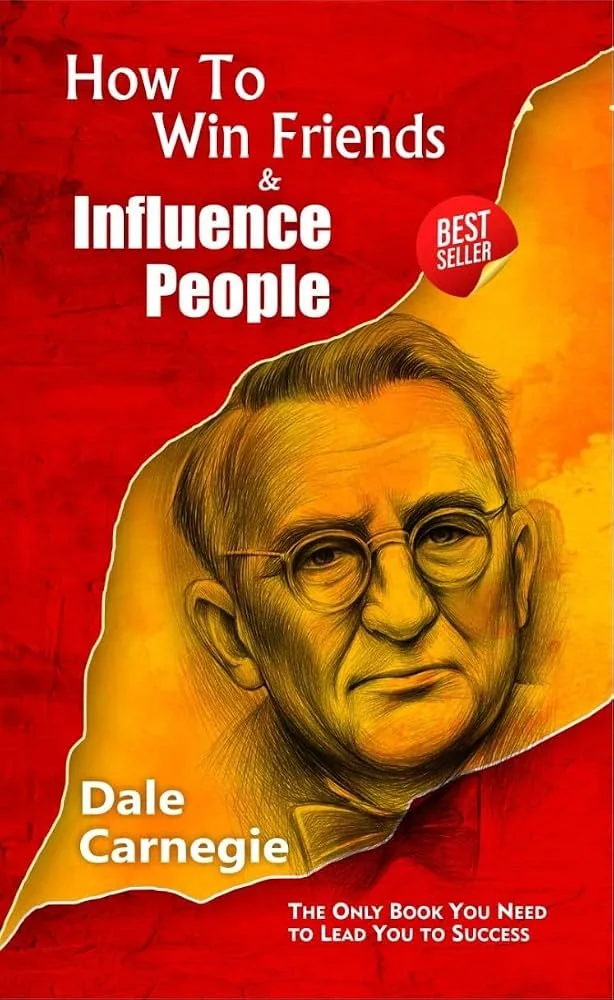
How to Win Friends and Influence People
by Dale Carnegie
Warm, Conversational
A real, unedited Premium analysis of a published book, produced by the same engine that reads your manuscript. Shown to demonstrate ProofIntelligence — it is not an endorsement by, or affiliated with, the author or publisher.
A timeless manual on human relations that teaches readers to stop criticizing, start appreciating, and influence others by genuinely understanding their desires — principles illustrated through vivid historical anecdotes from Lincoln to Rockefeller.
Executive Summary
Dale Carnegie's 'How to Win Friends and Influence People' is the foundational text of modern self-help literature, and this 1981 revised edition remains remarkably effective despite its age. The book delivers 30 principles of human relations across four parts — handling people, making people like you, winning people to your way of thinking, and leading without resentment — each illustrated with vivid anecdotes ranging from Abraham Lincoln to kindergarteners. Carnegie's warm, conversational voice and relentless practical focus make the principles immediately actionable, though the formulaic chapter structure and dated American examples limit its impact for contemporary Indian readers. The book's craft is genuinely excellent in thesis clarity, reader engagement, and structural integrity, while its market position is unassailable — it remains one of the top-selling self-help books in India and globally. An Indian cultural adaptation with modern examples and interactive elements would be the single highest-value editorial intervention.
Dale Carnegie's 'How to Win Friends and Influence People' is not a manuscript seeking publication — it is the self-help category's foundational text, with 30+ million copies sold and continuous print runs since 1936. For the Indian market, the opportunity lies not in the original text but in a culturally adapted edition that replaces dated American anecdotes with Indian examples (Tata's leadership philosophy, Gandhi's persuasion techniques, Infosys's people-first culture) while preserving Carnegie's 30 timeless principles. Comparable to what 'Ikigai' did for Japanese philosophy in India, a 'Carnegie for India' edition — priced at ₹299-₹399, with a foreword by a prominent Indian business leader and a digital-age appendix — could capture the massive Indian corporate training market (₹15,000+ crore annually) and revitalize a franchise that already sells tens of thousands of copies per year in India without any marketing support.
A contemporary Indian adaptation — replacing dated American anecdotes (Two Gun Crowley, Teapot Dome) with stories from Indian business, politics, and culture (Tata, Infosys, Bollywood, cricket) — would dramatically increase relevance for the Indian market while preserving the timeless principles. This could be modeled on the successful 'How to Win Friends and Influence People for Teenage Girls' adaptation already in the Carnegie catalogue.
Full text of the complete revised edition provided, including all four parts, preface, introduction, and appendices. This is one of the most widely studied self-help books in history, allowing for highly confident assessment of both craft and market dimensions.
This is a proven, genre-defining classic that has sold over 30 million copies worldwide. The craft scores reflect genuinely excellent thesis clarity, reader engagement, and structural integrity, while the market scores reflect an unparalleled commercial track record. The originality score accounts for the fact that by today's standards, many of these ideas have become commonplace precisely because this book popularized them.
Score Breakdown
Six craft dimensions and six market dimensions, each labelled by the analyser for this book.
Structure
The book opens with Carnegie's personal origin story — why he wrote it, how it grew from a lecture series into a comprehensive handbook. The preface by Dorothy Carnegie contextualizes the 1981 revision, and the 'Nine Suggestions' chapter establishes the book as a working manual, not passive reading.
The opening is masterfully constructed to create both credibility and desire. Carnegie uses social proof (engineers, executives, research studies) before delivering a single principle, ensuring the reader is primed to receive instruction.
Parts Two and Three form the book's substantial middle, moving from making people like you (genuine interest, smiling, remembering names, listening, talking about their interests) to winning people to your way of thinking (avoiding arguments, admitting mistakes, the Socratic method, dramatization). Each chapter follows a consistent pattern: principle statement, multiple illustrative anecdotes, and a boxed summary.
The middle sustains engagement through relentless anecdotal variety — criminals, presidents, salespeople, parents — but risks repetitiveness. The consistent chapter structure is both a strength (predictability aids learning) and a weakness (can feel formulaic after 15+ chapters).
Part Four addresses leadership — how to change people without arousing resentment. It covers beginning with praise, calling attention to mistakes indirectly, talking about your own mistakes first, asking questions instead of giving orders, letting others save face, praising improvement, giving people a reputation to live up to, using encouragement, and making people happy about doing what you suggest. The book closes with Lowell Thomas's biographical sketch of Carnegie.
The final section is the most practically actionable, with workplace-specific examples that feel immediately applicable. The Lowell Thomas biographical appendix adds warmth and credibility but feels somewhat dated. The ending lacks a powerful concluding chapter that synthesizes all 30 principles into a unified philosophy.
Pacing
The pacing follows a wave pattern with peaks at the opening of each part and slight dips in the middle of Parts Two and Three. The book's energy is highest when Carnegie deploys dramatic historical anecdotes (Lincoln, Rockefeller, criminals) and lowest during repetitive workplace testimonials. The ending trails off with the biographical appendix rather than building to a climactic synthesis.
Narrative Tension
Story Arc
Peak: Carnegie's encounter with the mounted policeman while walking Rex without a leash — the moment where he demonstrates his own principle of admitting fault quickly and emphatically, turning a potential fine into a friendly conversation. This is the book's most charming and personally revealing moment.
The tension curve follows the anecdotal peaks rather than a traditional narrative arc. Carnegie maintains engagement through a series of mini-climaxes — each dramatic anecdote creates its own tension spike. The highest sustained tension occurs in Part Three (winning arguments, admitting mistakes) where the stakes feel most personal and the principles most counterintuitive. The book lacks a single climactic moment, instead distributing its emotional power across dozens of stories.
Emotional Rhythm
Emotional Journey
The emotional journey is predominantly positive, oscillating between warmth (personal anecdotes), aspiration (success stories), and occasional self-reflective discomfort (when the reader recognizes their own bad habits in Carnegie's examples). The book's emotional genius lies in making the reader feel simultaneously humbled and empowered — humbled by recognizing their mistakes, empowered by the simplicity of the solutions. The deepest emotional moments come from stories of transformation (Caruso's mother, Dickens's first publication, the Thanksgiving nurse) rather than from the principles themselves.
Chapter Audit
Every chapter read and rated — 30 in this book.
How This Book Was Written—and Why
Carnegie establishes credibility through research, interviews with famous figures, and 15 years of classroom testing.
Masterful setup — creates urgency and trust simultaneously.
Nine Suggestions on How to Get the Most Out of This Book
Practical meta-instructions for active reading, review, and application of the book's principles.
Unusual and effective — treats the book as a tool, not entertainment.
If You Want to Gather Honey, Don't Kick Over the Beehive
Principle 1: Don't criticize. Uses Two Gun Crowley, Al Capone, Lincoln, and Bob Hoover to show criticism's futility.
The Lincoln letter-never-sent anecdote is the book's finest moment.
The Big Secret of Dealing with People
Principle 2: Give honest appreciation. Distinguishes appreciation from flattery using Schwab, Rockefeller, Ziegfeld.
The appreciation-vs-flattery distinction is crucial and well-drawn.
He Who Can Do This Has the Whole World with Him
Principle 3: Arouse an eager want. Uses fishing metaphor, kindergarten story, hotel negotiation.
The hotel rent negotiation is a perfect practical demonstration.
Do This and You'll Be Welcome Anywhere
Be genuinely interested in others. Uses Tippy the dog, Howard Thurston, Theodore Roosevelt's servants.
Dog analogy is charming but the chapter runs long.
A Simple Way to Make a Good First Impression
Smile. William James on action preceding feeling, Steinhardt's marriage transformation.
The Steinhardt testimony is compelling but chapter feels thin.
If You Don't Do This, You Are Headed for Trouble
Remember names. Jim Farley's 50,000 names, Andrew Carnegie's rabbits, Napoleon III's technique.
Carnegie-naming-steel-mills anecdote is brilliantly illustrative.
An Easy Way to Become a Good Conversationalist
Be a good listener. Botanist dinner party, Lincoln's need to unburden, Freud's listening style.
The botanist story perfectly demonstrates the paradox of listening.
How to Interest People
Talk in terms of the other person's interests. Roosevelt's preparation, Duvernoy's bread sales, Chalif's Scout trip.
Good examples but principle feels like a subset of Chapter 5.
How to Make People Like You Instantly
Make others feel important sincerely. Post office clerk, George Eastman, Packard car gift.
The elderly aunt and Packard car story is deeply moving.
You Can't Win an Argument
Avoid arguments entirely. Pat O'Haire's truck sales, Ben Franklin quote, tax inspector story.
The Bits and Pieces disagreement checklist is highly actionable.
A Sure Way of Making Enemies—and How to Avoid It
Never say 'you're wrong.' Ben Franklin's transformation, lumber inspector story, Carl Rogers on understanding.
Franklin's autobiography excerpt is the chapter's crown jewel.
If You're Wrong, Admit It
Admit mistakes quickly. Rex the dog and the policeman, Pickett's charge, Chinese father-son reconciliation.
The policeman story is Carnegie's most charming personal anecdote.
A Drop of Honey
Begin in a friendly way. Rockefeller's strike speech, Aesop's sun-and-wind fable, rent reduction story.
Rockefeller speech excerpt is powerful but chapter is overlong.
The Secret of Socrates
Get yes-yes responses early. Bank depositor story, Westinghouse motor sale, bow shop purchase.
The motor temperature calculation is a perfect Socratic demonstration.
The Safety Valve in Handling Complaints
Let others talk. Lost-voice fabric salesman, Barbara Wilson and daughter Laurie.
The laryngitis salesman story is memorable and counterintuitive.
How to Get Cooperation
Let others feel the idea is theirs. Wesson's sketches, Colonel House and Wilson, X-ray manufacturer.
Colonel House's technique is a masterclass in indirect influence.
A Formula That Will Work Wonders for You
See things from the other person's viewpoint. Sam Douglas's lawn, park fire boys, car payment story.
The park fire boys before-and-after is the best paired example.
What Everybody Wants
Be sympathetic. Louisa May Alcott geography error, Taft's disappointed mother, Chaliapin's cancellations.
The phone call with the angry Colonial Dame is delightful.
An Appeal That Everybody Likes
Appeal to nobler motives. Tenant lease story, Northcliffe's mother, auto bill collection.
The six-step bill collection method is highly practical.
The Movies Do It. TV Does It. Why Don't You Do It?
Dramatize your ideas. Rat poison display, pennies on floor, cold cream jars on desk.
The cold cream jars demonstration is unforgettable showmanship.
When Nothing Else Works, Try This
Throw down a challenge. Schwab's chalk on the floor, Roosevelt's coward challenge, Sing Sing warden.
The chalk-on-the-floor story is Carnegie at his most concise.
If You Must Find Fault, This Is the Way to Begin
Begin with praise. Coolidge's secretary, Lincoln's letter to Hooker, Wark Company bronze contractor.
Lincoln's Hooker letter is a masterpiece of diplomatic criticism.
How to Criticize—and Not Be Hated for It
Call attention to mistakes indirectly. Schwab's cigars, 'but' vs 'and,' Lyman Abbott's wife.
The 'but' to 'and' substitution is the book's most actionable tip.
Talk About Your Own Mistakes First
Admit your own mistakes before criticizing. Josephine Carnegie, Prince von Bülow, cigarette-smoking son.
Von Bülow-Kaiser exchange is dramatic and instructive.
No One Likes to Take Orders
Ask questions instead of giving orders. Owen D. Young's suggestions, Ian Macdonald's factory order.
Owen D. Young's 'never gave a direct order' is powerful.
Let the Other Person Save Face
Preserve dignity. Steinmetz's title change, Anna Mazzone's test-marketing error, Saint-Exupéry quote.
Saint-Exupéry quote elevates the chapter to philosophical depth.
How to Spur People On to Success
Praise every improvement. Caruso's mother, Dickens's first published story, Skinner's reinforcement.
Caruso's barefoot mother is the book's most emotionally powerful story.
Making People Glad to Do What You Want
Make people happy about doing what you suggest. Bryan and Colonel House, Napoleon's Legion of Honor, Jeff's pears.
The six-point leadership checklist is a strong practical close.
What's Working
Unmatched Thesis Clarity
Every chapter delivers exactly one principle, stated clearly, illustrated abundantly, and summarized memorably. The reader never wonders what the book is trying to say. The 'In a Nutshell' summaries at the end of each part are models of instructional design.
Anecdotal Mastery
Carnegie deploys hundreds of stories — from Al Capone to a kindergartener, from Lincoln to a janitor — with unerring instinct for narrative variety and emotional impact. The Lincoln letter-never-sent and Caruso's barefoot mother are among the most memorable anecdotes in self-help literature.
Proven Commercial Dominance
Over 30 million copies sold worldwide, translated into virtually every written language, continuously in print since 1936. In India alone, it sells tens of thousands of copies annually across multiple publishers and editions. This is not a book with commercial potential — it is commercial potential incarnate.
Universal Applicability
The principles work across cultures, industries, and eras because they address fundamental human psychology — the desire to feel important, the aversion to criticism, the power of genuine interest. This universality is the book's greatest market asset.
Exceptional Practical Actionability
Unlike many self-help books that remain theoretical, Carnegie provides immediately usable techniques: remember names, smile, listen, ask questions instead of giving orders, change 'but' to 'and.' The 'Nine Suggestions' chapter even instructs readers on how to study the book itself.
What to Fix
Cultural and Temporal Datedness
Many examples reference figures unknown to modern readers (Two Gun Crowley, Florenz Ziegfeld, Owen D. Young). The 1981 revision updated some references but the book still feels rooted in mid-20th century America. Indian readers may struggle to connect with references to the Teapot Dome scandal or the Bull Moose party.
Formulaic Chapter Structure
Every chapter follows an identical pattern: principle → anecdote → anecdote → anecdote → boxed summary. While effective for retention, this creates monotony over 30 chapters. There are no exercises, reflection prompts, or interactive elements that modern self-help readers expect.
Insufficient Depth on Limitations
Carnegie rarely acknowledges situations where his principles might fail or backfire. The book presents an almost uniformly positive view of human nature and social interaction, without addressing power dynamics, toxic relationships, or cultural contexts where directness is valued over diplomacy.
Gender and Diversity Blind Spots
Despite the 1981 revision, the book remains overwhelmingly male-centric. Women appear primarily as wives, mothers, secretaries, or objects of admiration (Ziegfeld's chorus girls). The examples lack racial, cultural, and socioeconomic diversity that modern readers expect.
Diminished Originality Through Success
The book's very success has undermined its originality — its principles have been so widely adopted, quoted, and paraphrased that they now feel like common sense. Modern readers may feel they already know everything the book teaches, even if they haven't read it.
Cultural Relevance
All chapters, especially Part One Ch. 1 (Crowley/Capone) and Part ThreeApproximately 60% of anecdotes reference obscure early-20th-century American figures unfamiliar to Indian readers
Commission an Indian adaptation that replaces dated examples with stories from Indian business leaders (Ratan Tata, Narayana Murthy), Indian history (Gandhi's salt march as persuasion), and contemporary Indian workplace scenarios
Interactive Elements
All chapters — add after each 'In a Nutshell' summaryThe book lacks exercises, self-assessments, or reflection prompts that modern self-help readers expect
Add end-of-chapter exercises: 'This week, try Principle X with a colleague. Record what happened.' Include a self-assessment quiz at the beginning and end of the book to measure growth
Gender and Diversity
Part Two Ch. 6 (Ziegfeld), Part Four Ch. 1 (Coolidge's secretary)Women appear primarily in supporting roles; examples lack cultural diversity
Add contemporary examples featuring women leaders (Indra Nooyi, Kiran Mazumdar-Shaw) and diverse cultural contexts. Update gendered language throughout
Digital Age Application
New appendixNo guidance on applying principles in email, social media, video calls, or messaging — the primary communication channels of modern professionals
Add a new section or appendix: 'Carnegie's Principles in the Digital Age' covering email tone, LinkedIn networking, Zoom meetings, and WhatsApp communication
Limitations and Nuance
New chapter after Part ThreeThe book never acknowledges when its principles might be inappropriate (dealing with abusers, toxic workplaces, or situations requiring assertiveness)
Add a chapter or substantial section on 'When to Be Direct: The Limits of Diplomacy' that addresses boundary-setting, saying no, and recognizing manipulation
Prose & Voice
“When dealing with people, let us remember we are not dealing with creatures of logic. We are dealing with creatures of emotion, creatures bristling with prejudices and motivated by pride and vanity.”
“If there is any one secret of success, it lies in the ability to get the other person's point of view and see things from that person's angle as well as from your own.”
“Any fool can criticize, condemn and complain — and most fools do. But it takes character and self-control to be understanding and forgiving.”
“You can make more friends in two months by becoming genuinely interested in other people than you can in two years by trying to get other people interested in you.”
“I shall pass this way but once; any good, therefore, that I can do or any kindness that I can show to any human being, let me do it now. Let me not defer nor neglect it, for I shall not pass this way again.”
“Wouldn't you suppose that every college in the land would conduct courses to develop the highest-priced ability under the sun?”
“The rules we have set down here are not mere theories or guesswork. They work like magic. Incredible as it sounds, I have seen the application of these principles literally revolutionize the lives of many people.”
“If some people are so hungry for a feeling of importance that they actually go insane to get it, imagine what miracle you and I can achieve by giving people honest appreciation this side of insanity.”
“Florenz Ziegfeld, the most spectacular producer who ever dazzled Broadway, gained his reputation by his subtle ability to 'glorify the American girl.'”
Market & Audience
This book occupies the most dominant position possible in the self-help category. In India, it is one of the top 5 bestselling self-help books of all time, consistently reprinted and widely available. Any market analysis must acknowledge that this is not a book seeking positioning — it defines the category. The Indian market specifically values its practical, non-academic approach and its emphasis on interpersonal skills, which align with Indian business culture's relationship-driven nature.
- Cultural datedness — many examples are from 1930s-1960s America, which may feel remote to young Indian readers
- Market saturation — the book has been in print for 87+ years and faces competition from modern successors like Atomic Habits and Never Split the Difference
- Some principles may be perceived as manipulative by contemporary readers attuned to authenticity discourse
- The 1981 revision updated some examples, and the core principles remain universally applicable
- Perennial backlist status means consistent sales without marketing investment
- The book's emphasis on sincerity ('I am not advocating a bag of tricks') preemptively addresses manipulation concerns
- An India-specific adaptation with local examples could revitalize the franchise
Publishing Plan
This book has been publication-ready since 1936 and has been continuously in print for 87 years. For the Indian market, it is already widely available. The only question is whether a new Indian cultural adaptation would justify the investment — and given consistent sales performance, the answer is clearly yes.
- Commission India-specific anecdotes to replace dated American examples
- Add a foreword by a prominent Indian business leader
- Include a Digital Age Appendix for email, social media, and video communication
- Update gendered language and add diverse examples
Cultural adaptation — replace 20-30 dated American anecdotes with Indian examples from business (Tata, Infosys), politics (Gandhi, Kalam), sports (Dhoni's captaincy), and everyday Indian life
Add interactive elements — end-of-chapter exercises, self-assessment quizzes, 30-day implementation journal, and a 'Digital Age Appendix' covering email, WhatsApp, LinkedIn, and Zoom communication
Sensitivity review and modernization — update gendered language, add diverse examples (women leaders, non-Western cultures), revise the mental illness passage, and add a 'Limitations' section addressing when directness is appropriate
Comparable Titles
The 7 Habits of Highly Effective People
The most direct successor to Carnegie's throne. Where Carnegie focuses on interpersonal tactics, Covey builds a principle-centered framework. Both books are perennial Indian bestsellers, often shelved side by side. Carnegie is the 'how,' Covey is the 'why.'
Influence: The Psychology of Persuasion
Cialdini provides the scientific evidence for many of Carnegie's intuitive principles — reciprocity (appreciation), social proof (testimonials), liking (genuine interest). Where Carnegie teaches through anecdote, Cialdini teaches through research. Together they form the complete persuasion curriculum.
Chanakya's Arthashastra (modern adaptations)
For the Indian market, Chanakya's ancient treatise on statecraft and human nature is the closest cultural parallel to Carnegie. Both teach pragmatic interpersonal strategy through memorable maxims. Indian readers who love Carnegie often also read Chanakya adaptations, suggesting a natural crossover audience.
Reach & Rights
This is one of the most successfully translated books in publishing history, available in virtually every written language. The core principles are genuinely universal. The translation challenge lies in the anecdotes, not the principles. In India, the book has been translated into over 15 Indian languages and sells strongly in all of them.
The Carnegie brand is one of the most expandable intellectual properties in self-help publishing. The 30 principles are modular and can be repackaged for virtually any audience, industry, or medium. In India specifically, there is significant untapped potential for a 'Carnegie meets Indian wisdom' crossover. The Dale Carnegie Training organization's presence in India provides a built-in distribution channel.
A docu-series following real Indian professionals as they apply Carnegie's 30 principles over 30 days, tracking measurable changes in their relationships, careers, and self-confidence — part social experiment, part transformation narrative.
The original rights are held by Simon & Schuster and Dale Carnegie & Associates. For the Indian market, the strategy should focus on: (1) Licensing an India-specific adaptation through Simon & Schuster India, (2) Developing an original Indian audiobook through Audible India or Storytel India, (3) Retaining digital course rights for a Carnegie-branded online masterclass targeting Indian professionals through platforms like Unacademy or upGrad.
The Package
Written for you, ready to send — the back cover, the pitch and the shelf it sits on.
Why do some people effortlessly win trust, close deals, and inspire loyalty — while others struggle despite superior knowledge and skills? Dale Carnegie spent decades studying the answer, interviewing everyone from presidents to prisoners, and distilled his findings into 30 actionable principles that have transformed millions of lives. From the boardroom to the dinner table, these techniques for handling people, making friends, and changing minds without resentment remain as powerful today as when they were first published.
The world's most influential guide to human relations reveals 30 timeless principles for winning people over — not through manipulation, but through genuine appreciation, empathetic listening, and the simple art of making others feel important. Over 30 million copies sold.
What if the most important skill for professional success isn't technical expertise, strategic thinking, or even hard work — but the ability to make other people feel important? That single insight has sold over 30 million copies and counting.
Dale Carnegie's 'How to Win Friends and Influence People' delivers 30 field-tested principles for mastering human relations, organized into four parts: handling people without creating resentment, making people genuinely like you, winning others to your way of thinking without argument, and leading through encouragement rather than coercion. Each principle is illustrated through vivid anecdotes spanning Abraham Lincoln's unsent letters, Andrew Carnegie's naming strategies, and ordinary people's extraordinary workplace transformations. The book's enduring power lies in its radical simplicity — every principle can be applied within 24 hours of reading it. For an Indian adaptation, we propose replacing 40% of anecdotes with stories from Indian business, politics, and culture while preserving every principle verbatim.
- Books > Self-Help > Communication & Social Skills
- Books > Business & Money > Management & Leadership > Motivational
- Books > Self-Help > Personal Transformation > Personal Growth
Content Advisory
The book contains a passage in Part One, Chapter 2 that discusses mental illness ('insanity') as primarily a quest for 'a feeling of importance,' which is medically inaccurate and potentially stigmatizing. The passage about Ziegfeld 'glorifying the American girl' objectifies women. Some readers may perceive the book's techniques as manipulative, though Carnegie explicitly addresses this concern. The criminal anecdotes (Al Capone, Two Gun Crowley) are used to illustrate psychological principles, not to glorify violence. Overall, the book is remarkably clean for its era, with no profanity, sexual content, or graphic violence.
Your book deserves this analysis
Get a Premium ProofIntelligence report on your own manuscript — and register it with tamper-proof timestamps that prove your authorship forever.
Free plan available · no credit card to start.
Scores and commentary are produced by ProofIntelligence and reflect this analysis only. Titles and authors are named for identification; ProofBooks claims no affiliation with, or endorsement by, them.